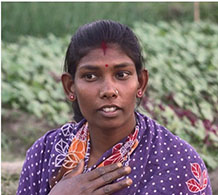
Joba Murmu: A paralegal’s fight for the equal wage
Joba Murmu, an indigenous woman from Kornai village in Dinajpur Sadar, is a paralegal worker who led her community's women workers in a fight for equal wages. Her achievement marks a significant and previously unimaginable step forward.
"Women get less than men because they are women"—this traditional belief has long perpetuated wage discrimination. While state laws do not condone it, wage disparities based on gender, societal norms and informal labor practices remain entrenched in patriarchy. Changing these norms is crucial, and the Equal Stake Under Soil Project has been working toward this goal since 2022.
During the project's initiation, background research revealed stark wage disparities: men earned 500 BDT (about $5) while women earned 250-300 BDT (about $3) for the same work. Most women in the pilot location work in agriculture for powerful landowners, known locally as Jotedars, who are resistant to wage increases. Through the project, we organized and mobilized women workers, involving Union Council members and agricultural officers to pressure landowners, but initial responses were unpromising.
However, the indigenous women of Dinajpur, led by Joba Murmu, adopted a different strategy and succeeded in raising their wages, though equality remains elusive. Joba and other indigenous women, who work as day laborers due to their limited land ownership, faced compounded discrimination due to both their gender and indigenous identity. Actively involved in the project from the beginning, Joba received paralegal training on land literacy, which empowered her to advocate for her community's rights.
"We never talked about wages, fearing job loss," Joba said. "But I learned from the S4HL meetings that it is our right to claim equal pay. After receiving paralegal training, I felt responsible for leading our community in this fight."
Initially, Joba's individual and collective appeals to landowners were met with resistance. Undeterred, she sought support from Union Council representatives and local elites. Finding no other recourse, Joba mobilized the women workers, deciding to demand wage increases or refuse to work. "One landowner initially refused," Joba recounted, "but when he saw that no women would work for less, he agreed to raise wages." As a result, their pay increased from 300 BDT to 400 BDT, with other landowners following it.
Joba remains hopeful: "If we stand together, we will one day achieve equal wages with men." The women workers have also adopted a new strategy, forming teams to contract agricultural tasks like planting and harvesting. "I feel empowered to make changes, thanks to the support from S4HL," Joba said.
Joba Murmu's leadership and the collective efforts of the women workers in Kornai village highlight the power of unity and education in challenging entrenched social norms and achieving incremental but significant progress toward wage equality.